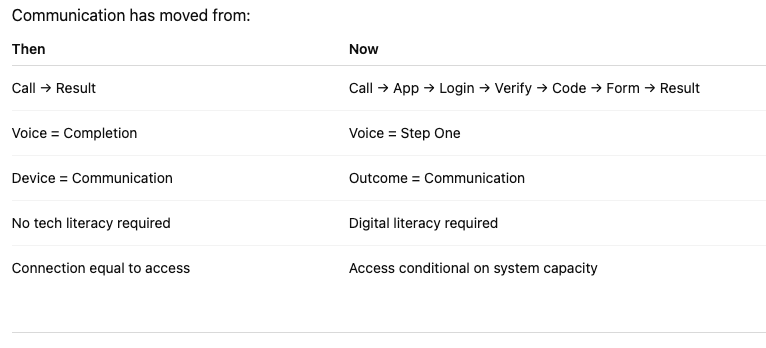
Communication is the outcome, not the device.
Communication used to be simple. Now it’s a barrier.
THE PROBLEM
Most people assume communication still means making a phone call.
They look at a handset, hear a dial tone, and think:
“He’s connected. She’ll be fine. They can call if they need help.”
But look closer at almost any home today:
• NBN connection dependent on electricity
• VoIP phones that go dead in a blackout (all landline are VoIP)
• iPads and Phones can be too old to run MyGov or Medicare
• Banking apps required — but unsupported on old phones
• Government portals demanding verification codes
• Identity checks people don’t know how to complete
• Online-only forms replacing face-to-face services
A person may be able to call —
but they cannot complete anything.
Communication hasn’t failed at the voice.
It has failed at the outcome.
And when communication fails today, the consequences are real.
A client can ring Centrelink (hour wait) —
but can’t verify through the app.
The call goes nowhere.
They can dial a bank —
but the branch is closed,
they need digital banking to buy food,
and their phone is too old to run it.
They want to book transport —
but the service only accepts digital requests.
They try to access MyGov —
but software is outdated, passwords forgotten,
two-factor codes never arrive,
and anxiety takes over.
The device works.
The task does not.
And in that moment, independence collapses.
Not because of ability —
but because communication is now multi-step, multi-system, multi-skill.
The industry moved.
The definition didn’t.
Vulnerable people were left behind.
SOLUTION
That’s where I step in.
Communication is the outcome — not the device.
My work is not to make phones ring.
It’s to make sure the result happens.
I build and maintain communication pathways so vulnerable people can:
• verify identity
• access MyGov and Medicare
• use digital banking to buy food
• submit forms, request services, book transport
• communicate with support workers and family
• ask for help and receive it
• complete the task — not just start it
I don’t install technology.
I restore access.
I prevent silent communication breakdown by:
• performing system health checks
• maintaining logins, passwords, accounts
• updating devices and apps
• building fail-safes and backups
• ensuring communication still works tomorrow
• protecting independence long-term
My goal is simple:
Communication must work when it’s needed — not when it’s convenient.
WHY I DO IT
I worked inside major telcos when this shift began.
I saw homes where everything looked connected,
yet nothing could be completed.
And I realised:
Devices weren’t failing.
Support systems were.
No one was bridging the gap.
So I built a role that does.
If you’re reading this, you already understand the stakes.
Communication is not a phone call.
It is everything required to complete the task.
And I help make sure that happens every time.
Next Step
If you support someone who needs communication reliability — real reliability —
you don’t need a device specialist.
You need an outcome specialist.
Reach out.
We can make communication work.
Timeline: How Communication Changed in Australia
From dial tone → to digital identity → to outcome-dependent access
1. Before 2013 – Phone Calls Were Communication
Single step = call → result
• Banks, Medicare, Centrelink all handled tasks over the phone
• No passwords, no accounts, no verification apps
• Communication = speaking to a person
• Vulnerable people could always communicate
(Phone alone was enough)
2. 2013 – myGov launches
[ANAO Audit Report]
• Services begin linking into a central portal
• Login required → first dependency step
• Beginning of self-service culture
• Phone starts losing authority
Communication now requires account access
3. 2014–2019 – Rapid shift to self-service digital portals
• Tax, Centrelink, Medicare, Child Support all moved online
• Fewer tasks completed over the phone
• More forms moved to web-only submission
• Help centres shifted toward “do it online instead”
Communication = device + skill + internet
4. 2020 – Mandatory 2FA for telco number transfers
[ACMA / Auth0 reference]
• Identity verification becomes required for basic communication tasks
• One step becomes several: Login → Code → Confirm → Outcome
Communication is no longer verbal — it’s procedural
5. 2022 – myGov official smartphone app released
Mobile-first access to Medicare, Centrelink, ATO
• Device + app + account required
• Digital identity becomes key to access
• No compatible phone = no access to services
Communication = device + identity pipeline
6. Nov 2024 – myGovID renamed myID (Digital Identity upgrade)
• Identity becomes a core requirement for government service access
• The person must authenticate → not just speak
• Completion relies on device + updates + codes + accounts
Communication = workflow, not dial tone